

Introduction
Business capability mapping is a structured approach to visually representing what an organization can do, independent of how it currently does it. It gives enterprise architects, CIOs, and business leaders a shared model of organizational capabilities that can be linked to strategy, IT systems, processes, and people.
This wiki covers what business capability mapping is, how to create a business capability map step by step, examples of capability map formats, best practices for documenting business capabilities, and how capability-based planning and roadmapping connect capabilities to strategic outcomes.
What is Business Capability Mapping?
Business capability mapping is a process that involves visually representing and documenting an organization's capabilities and how they interrelate. It provides a holistic view of what an organization can do to execute its business strategy. Unlike traditional process mapping, which focuses on how tasks are performed, business capability mapping focuses on what the organization is capable of achieving. A business capability is a particular ability or expertise required to perform a core business function. It encompasses the people, processes, technologies, and resources necessary to deliver specific outcomes. By mapping these capabilities, organizations can gain a clear understanding of their internal strengths and weaknesses, identify areas for improvement, and align their resources to achieve strategic goals.
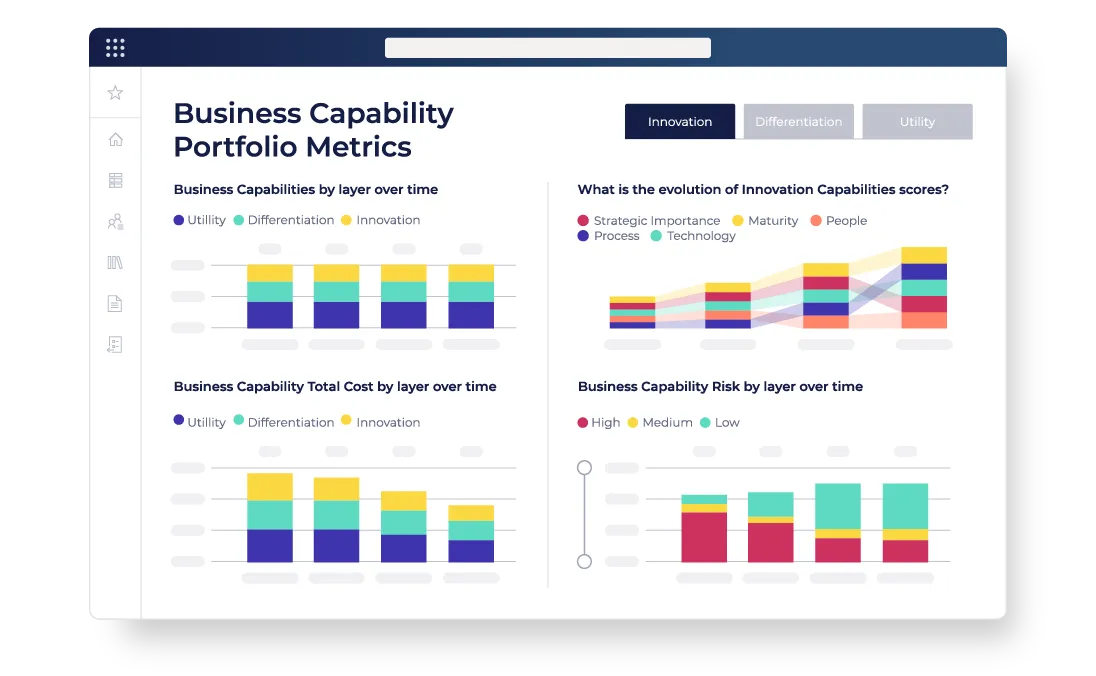
A business capability map is the visual output of the mapping process. It is typically presented as a hierarchical box-in-box layout, where each box represents a discrete capability grouped into higher-level domains. The map shows what the organization can do across its key functions, structured into levels:
- Level 1 (Capability Domains): High-level groupings such as Strategy, Core Operations, Customer Engagement, or Finance
- Level 2 (Core Capabilities): Major abilities within each domain, such as Customer Relationship Management or Manage Supplier Relationships
- Level 3 (Sub-capabilities): More detailed capabilities that can be assessed, prioritized, and linked to applications or processes
Business capability maps differ from org charts and process diagrams in three important ways: they are stable (they do not change with restructures), outcome-oriented (they define what the business can do, not how), and technology-agnostic (they separate business needs from IT solutions). This stability makes them a foundational reference model for enterprise architecture, portfolio management, and transformation planning.
The Benefits of Business Capability Mapping
Business capability mapping offers a range of benefits for organizations seeking to optimize their operations and drive innovation. These benefits include:
- Enhanced Strategic Alignment: By mapping their capabilities, organizations can align their resources and activities with their strategic goals. This alignment ensures that every capability contributes directly to the organization's overall objectives, eliminating redundancies and improving efficiency.
- Improved Decision-Making: Business capability mapping provides organizations with a comprehensive view of their capabilities, enabling better decision-making. It helps leaders understand the impact of their decisions on different business functions and identify potential risks and opportunities.
- Agility and Adaptability: In today's dynamic business environment, organizations need to be agile and adaptable. Business capability mapping allows organizations to quickly identify areas where new capabilities are needed to respond to market changes and customer demands. It provides a roadmap for building the necessary capabilities to stay competitive.
- Resource Optimization: By identifying their core capabilities, organizations can optimize their resource allocation. They can focus their investments on the capabilities that provide the most value and competitive advantage while divesting or outsourcing non-core capabilities.
- Improved Collaboration and Communication: Business capability mapping promotes cross-functional collaboration and improves communication within the organization. It provides a common language and understanding of capabilities, enabling teams to work together more effectively towards shared goals.
- Better Technology Decisions: By linking capabilities to applications, organizations can ensure IT investments are justified and aligned to specific business outcomes. Technologies that do not support value-adding capabilities can be deprioritized or retired through application rationalization.
- Enhanced Risk Management: Mapping capabilities and their dependencies to underlying systems surfaces vulnerabilities, such as critical capabilities relying on aging or unsupported technology. This enables proactive risk mitigation rather than reactive incident response.
How to Create a Business Capability Map
Business capability mapping involves several steps to develop a comprehensive and actionable capability map. These steps include:
- Step 1: Understand Strategic Objectives: Before defining any capabilities, understand where the organization is heading. Review strategy documents, business goals, and objectives, and engage stakeholders from the corporate development or strategy function. Capability mapping without strategic grounding produces a static inventory rather than an actionable model.
- Step 2: Identify High-Level Capabilities: Begin by identifying 5 to 10 Level 1 capabilities that represent the primary functions of the organization. Use a top-down approach (what does the organization exist to do?) combined with bottom-up insight from existing processes and structures. Define each capability using a consistent verb-noun format and provide a concise one-sentence definition to avoid ambiguity.
- Step 3: Develop the Capability Hierarchy: Expand each Level 1 capability into sub-capabilities, creating a multi-level hierarchy. Ensure capabilities are mutually exclusive (no overlap between them) and collectively exhaustive (all critical areas of the business are covered). Most organizations find three levels of depth sufficient, with around 10 top-level capabilities representing a lean, maintainable model.
- Step 4: Assess Capability Maturity and Gaps: Evaluate each capability against its strategic importance and current performance. Maturity levels such as Initial, Managed, Defined, Quantitatively Managed, and Optimized provide a structured framework for this assessment. This analysis identifies gaps where new capabilities need to be built and underperforming capabilities requiring investment or remediation.
- Step 5: Link Capabilities to Applications and Technology: Connect capabilities to the applications that support them. This step reveals which systems support which capabilities, where multiple applications support the same capability (a rationalization opportunity), and which capabilities depend on fragile or aging systems. This view is essential for application portfolio management and modernization decisions. OrbusInfinity supports this linkage within a central enterprise architecture repository, allowing architects to map capabilities to applications, data, and technology in a single governed model.
Developing a Business Capability Roadmap
A business capability roadmap is the planning layer that sits on top of the capability map. Where the map shows what the organization can do today, the roadmap shows how capabilities need to evolve over time to support strategic objectives.In capability-based planning, initiatives are prioritized based on the capabilities they improve or enable, rather than on projects or systems in isolation. The roadmap shows how capabilities evolve across defined time horizons, from the current state to the target state.A business capability roadmap typically includes:When managed within an enterprise architecture tool like OrbusInfinity, capability roadmaps can depict project timelines including impacted capabilities, dependent applications, and related initiatives, giving stakeholders from business to infrastructure a clear view of planned change.
- The current maturity level of each capability and the target maturity required to support strategic goals
- Initiatives or projects that will close the gap between current and target state
- Timeline, dependencies, and resource requirements for each initiative
- Links between capabilities and the applications or technology changes required to deliver them
When managed within an enterprise architecture tool like OrbusInfinity, capability roadmaps can depict project timelines including impacted capabilities, dependent applications, and related initiatives, giving stakeholders from business to infrastructure a clear view of planned change.
Examples of Business Capability Maps
There are different ways to visualize and present business capability maps. Some examples include:
Capability Tree: This is a hierarchical diagram that shows the relationships between different capabilities.
Capability Matrix: This is a grid that shows the level of fulfilment for each capability and the degree of importance to the organization.
Capability Heat Map: This is a graphical representation of capability fulfilment and importance, using colours to highlight areas of strength and weakness.
Nested Box Map: The most widely used format, presenting capabilities as boxes grouped into higher-level domains, with sub-capabilities nested within. This is the standard output of enterprise architecture tools and provides the clearest view for stakeholder communication.
In each format, capabilities are typically assessed and colour-coded by maturity or strategic importance, allowing leaders to quickly identify where investment or change is needed. OrbusInfinity supports multiple visualization formats for capability maps, including heat maps and nested views, directly within the platform's central repository.

Tools and Techniques for Business Capability Mapping
There are several tools and techniques that organizations can use to develop and maintain their business capability maps. These include:
Capability Modeling: This involves creating a formal model of the organization’s capabilities, often incorporating business process modeling to show how capabilities are enabled and executed. This can be done using standard notations such as ArchiMate or BPMN.
Capability Workshops: These are collaborative sessions that bring together stakeholders from different business functions to define and prioritize capabilities.
Capability Assessment: This involves evaluating the maturity and effectiveness of each capability using a framework such as COBIT.
Capability Roadmapping: This involves developing a roadmap for building the necessary capabilities to achieve strategic objectives.
Enterprise Architecture Platforms: Dedicated enterprise architecture tools such as OrbusInfinity provide a central repository for documenting business capabilities, linking them to applications and technology, and generating capability maps and heat maps directly from governed data. This removes the reliance on manually maintained spreadsheets or diagrams, ensuring the capability model stays accurate as the organization changes.
Documenting Business Capabilities
Documenting business capabilities is the process of formally capturing each capability's definition, scope, ownership, and relationships within a central repository. Well-documented capabilities are the foundation of an effective capability map and enable the broader analyses that make capability mapping valuable.
When documenting business capabilities, each entry should include:
- Name: Using a consistent verb-noun format, such as 'Manage Customer Relationships' or 'Deliver Products and Services'
- Definition: A single clear sentence that describes what the capability is, what outcome it delivers, and what it excludes
- Level: Its position in the capability hierarchy (Level 1, 2, or 3)
- Owner: The business unit or role responsible for the capability
- Maturity: The current maturity level, assessed against a defined scale
- Supporting applications: The applications and technologies that enable the capability
- Strategic importance: Whether the capability is core, supporting, or strategic
The most effective way to document business capabilities at scale is within a dedicated enterprise architecture platform. This ensures that capability documentation is connected to the rest of the architecture model, kept current as the organization changes, and accessible to stakeholders across the business without requiring architectural expertise to navigate.
Best Practices for Successful Business Capability Mapping
To ensure successful business capability mapping, organizations should follow these best practices:
- Involve stakeholders from across the organization in the mapping process.
- Use a consistent naming convention and clear definitions for capabilities.
- Regularly review and update the capability map to reflect changes in the business environment.
- Integrate capability mapping with other strategic planning processes, such as enterprise architecture or IT portfolio management.
- Focus on 'what', not 'how'. Capabilities define what the business can do, not the processes or systems used to do it. Keeping capabilities technology-agnostic ensures the map remains stable as tools and processes evolve.
- Avoid overlapping capabilities. Each capability should represent a distinct function or outcome. Redundancy in the map leads to confusion and undermines the governance value of the model.
- Start broad and add depth over time. Begin with 5 to 10 Level 1 capabilities and expand into sub-capabilities as the initiative matures. Attempting full granularity from the outset is a common reason capability mapping projects stall.
Integrating Business Capability Mapping with Strategy
Business capability mapping is most effective when it is integrated with the organization's overall strategy. This integration ensures that capabilities are aligned with strategic objectives and that the organization is focused on building the capabilities that provide the most value and competitive advantage.
Overcoming Challenges in Business Capability Mapping
There are several challenges that organizations may face when developing and maintaining their business capability maps. These include:
- Lack of stakeholder engagement
- Inconsistent or unclear definitions of capabilities
- Difficulty in assessing capability fulfilment
- Resistance to change
To overcome these challenges, organizations should focus on building a culture of collaboration and continuous improvement. They should also invest in training and education to ensure that stakeholders have the skills and knowledge needed to participate effectively in the mapping process.
Using a dedicated EA platform significantly reduces the data collection and maintenance burden. Rather than managing capability documentation in spreadsheets, OrbusInfinity provides a governed central repository where capabilities can be documented, assessed, visualized, and linked to applications and strategy in a single model accessible to all stakeholders
Business Capability Mapping in Action
There are many examples of organizations that have successfully implemented business capability mapping to drive innovation and optimize their operations. Some of the companies that Orbus Software has helped are:
Scottish Water
Scottish Water utilized Business Capability Mapping as part of its strategic Enterprise Architecture (EA) approach, facilitated by Orbus Software's OrbusInfinity. This method allowed them to clearly define and understand their organizational capabilities, aligning them with their strategic objectives. Through this mapping, Scottish Water could identify and prioritize areas for improvement, ensuring that their business capabilities were effectively supporting their overall business goals and enabling more informed decision-making processes. This approach was pivotal in enhancing their organizational efficiency and agility.
For a detailed understanding of their process, you can view the case study directly here.
SourceAmerica
OrbusInfinity played a crucial role in supporting the non-profit's transition to cloud-based operations and diversification of its customer base. SourceAmerica utilized OrbusInfinity to effectively document and define their application infrastructures and relationships. This process empowered enterprise architects to create a comprehensive resource accessible across the organization, enhancing understanding of business capabilities and driving informed decision-making in both IT and business sectors.
For a detailed overview, please refer to the case study directly here.
The Future of Business Capability Mapping
As organizations continue to face increasing competition and rapidly evolving business environments, the need for effective business capability mapping will only continue to grow. In the future, we can expect to see more organizations adopting this approach to optimize their operations, drive innovation, and achieve their strategic objectives.
AI is beginning to reshape how capability maps are created and maintained. EA platforms are increasingly using AI to automate data enrichment, suggest capability definitions, identify redundancies, and flag misalignments between capabilities and the applications that support them. For organizations managing complex, rapidly changing portfolios, AI-assisted capability mapping reduces the manual overhead that has historically made the discipline difficult to sustain.
Conclusion
Business capability mapping is a powerful tool that enables organizations to gain a clear understanding of their capabilities and align them with strategic goals. By documenting business capabilities in a structured, governed model, organizations can improve decision-making, drive more effective IT investment, and build the capability-based planning discipline needed to stay competitive. For organizations looking to implement business capability mapping, explore how OrbusInfinity supports capability documentation, assessment, and roadmapping within a broader enterprise architecture practice.
Frequently Asked Questions
What is a business capability map?
A business capability map is a visual model that shows what an organization can do, structured into logical capability domains and sub-capabilities. It is used to align strategy, business operations, and IT, providing a stable, outcome-oriented reference model for planning, investment, and transformation.
What is the difference between a business capability and a business process?
A business capability describes what the organization can do, while a process describes how the work is performed. Capabilities are stable over time; processes change as tools, roles, and methods evolve. Mapping capabilities rather than processes provides a more durable foundation for strategic planning.
What is a business capability roadmap?
A business capability roadmap is a planning model that shows how capabilities need to evolve over time to support strategic objectives. It maps the current and target maturity of each capability, the initiatives required to close the gap, and the technology changes needed to enable each capability.
What is involved in documenting business capabilities?
Documenting business capabilities involves formally capturing each capability's name, definition, hierarchy level, owner, maturity, supporting applications, and strategic importance in a central repository. This documentation forms the foundation of the capability map and enables the broader analyses that make capability mapping valuable.
How many levels should a business capability map have?
Most organizations use three levels of depth. Level 1 identifies 5 to 10 high-level capability domains. Level 2 breaks these into core capabilities. Level 3 adds sub-capabilities where greater detail is needed. Starting with Level 1 and expanding over time is the recommended approach.
How does business capability mapping relate to enterprise architecture?
Business capability mapping is a core discipline within enterprise architecture. The capability map serves as the anchor model that connects business strategy to IT architecture, application portfolios, and technology roadmaps. It provides the common language that enables business and IT teams to plan and communicate change effectively.