.webp)
AI’s momentum is undeniable – it’s reshaping products, processes, and expectations – but unmanaged proliferation creates real risk: security exposures, compliance gaps, runaway costs, and missed strategic opportunities. For executives, the question is simple: how do you take control of AI so it accelerates value instead of creating chaos?
At Gartner IT Symposium Barcelona this year, our VP of Product Innovation, Ed Granger, walked through why CIOs must take ownership of their organization’s AI estate and the role of enterprise architecture. Rather than a dusty diagram exercise, it provides living models and controls that give leaders a single, trusted view of where AI is used, what it’s doing, and how it affects customers, costs, and risk.
When CIOs combine automated discovery, governance automation, business-aligned language and a Digital Twin of the Organization (DTO), AI becomes manageable and strategic – not mysterious and risky.
Why CIOs must get a grip on AI now
- Reactive vs. strategic: AI’s benefits are huge – productivity, automation, and new products – but those benefits come with amplified risk when AI is invisible or unmanaged. AI proliferation is a leadership problem: technology leaders who can’t explain AI’s business impact are too often pulled into reactive operational firefighting instead of shaping strategy.
- Invisible AI is risky AI: When AI systems, models, and agents are running under the radar, they expose the organization to security incidents, compliance failures, and runaway costs. According to IBM, 97% of organizations with AI-related breaches lacked proper access controls, and the EU AI Act creates material penalties (up to €35m or 7% of global turnover) for prohibited practices — both clear call-to-actions for governance and transparency.
- Complexity multiplies risk: Shadow AI and autonomous agents increase operational complexity and the risk of unintended consequences. Organizations often can’t monitor data flows, model usage, or compliance posture – and without that visibility, risk simply compounds.
How enterprise architecture provides AI clarity, control, and connection
Enterprise architecture is more than documentation; it’s a model that makes systems, data flows, and decision rights visible. That model becomes the foundation to map AI assets to business value, risk, and controls, turning messy technical detail into boardroom-level decisions and making risk visible and actionable.
Four steps for CIOs to tame AI
Here are four clear, executive-friendly actions you can take now to bring AI under control and use it strategically.
- Create AI transparency (automate discovery and integrate into enterprise architecture)
- Problem: Manual inventories can’t keep up with the speed or scope of deployment. You need a real-time picture of every AI asset and where it sits in your business.
- What to do: Use automated discovery across cloud platforms, endpoints, access management, and collaboration tools. Leverage integration workflows to feed that inventory into your enterprise architecture repository to auto-classify AI assets, map them to business capabilities, and require every AI initiative to be registered and tracked.
- Automate AI governance (risk scoring, controls, dashboards)
- Problem: Manual governance is either too slow or too unfocused. You need consistent, proportionate controls at scale.
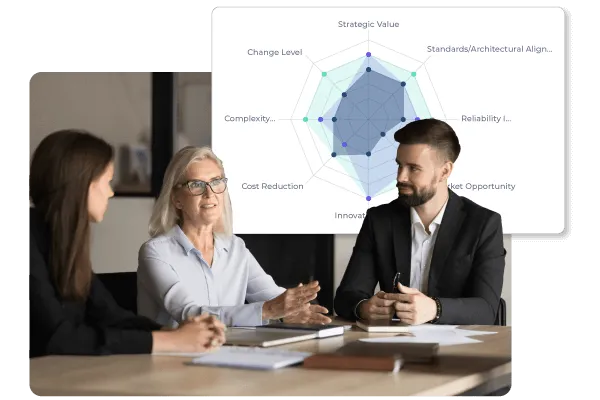
- What to do: Implement automated risk scoring for AI assets and initiatives. Use risk profiles to propose and assign controls (that are proportionate to the use case) from standard frameworks; embed design-time governance (approved technologies and reference patterns) to steer engineers toward safe choices; and surface centralized dashboards to continuously monitor risk, value, and control maturity so decisions to scale or retire initiatives are data-driven.
- Speak AI in business language (value streams and outcomes)
- Problem: If AI is discussed only in technical terms, it won’t get strategic funding or clear accountability. Many AI pilots fail to show measurable returns because they aren’t tied to outcomes.
- What to do: Use business architecture and value streams to translate technical projects into customer outcomes and financial impact. Require measurable KPIs (e.g., cost saved, revenue enabled, time-to-market improvement) and make owners accountable for those outcomes. Standardize evaluation criteria so governance is consistent and proportionate — not one-size-fits-all or overly conservative.
- Invest in AI-driven strategy (Digital Twin of an Organization)
- Problem: Even with governance and alignment, strategy-setting often remains manual and slow.
- What to do: Start by understanding the value a Digital Twin of the Organization (DTO) could deliver – faster, data-informed strategic trade-offs, real-time visibility across business and IT, and safe scenario testing. Prepare by consolidating high-quality operational and IT metrics, defining the strategic decisions you want to accelerate, and piloting small, well-scoped digital twins of processes or value streams (not the whole org). Experiment to understand how integrating a DTO with generative AI enables you to have strategic conversations with AI about the best strategic course of action.
Common AI pitfalls and how to avoid them
- Over-governing: Overly strict controls can stifle innovation. Use proportional governance – light touch for low-risk copilots, stricter controls for autonomous decision systems – driven by your automated risk scoring and business-impact mapping.
- Fragmented ownership: Make AI ownership explicit: who owns model risk, who owns data lineage, who signs off on production usage? Embed those responsibilities in your enterprise architecture artifacts and change processes.
- No consistent evaluation criteria: Define a standard risk vs. reward framework and scorecard so decisions are consistent across teams and initiatives.
AI is too important to leave to chance. With the right models, automation, and business translation, CIOs can turn AI from a risk-laden experiment into a dependable engine of value. Start with transparency, automate governance, speak the language of the business, and use DTOs to make strategic choices at AI speed. The CIO who leads on this will not only tame AI — they’ll hand the organization a clearer, faster route to sustainable transformation.
Discover how our enterprise transformation platform – OrbusInfinity – can help. Book a demo to explore AI-enabled queries, automated security checks, risk mapping, AI integrations, and an AI governance agent that flags AI projects for review.
About the speaker
Ed Granger is the Vice President of Product Innovation at Orbus Software, where he drives advancements in enterprise architecture tooling, technology, and future-focused solutions. With over two decades of experience practicing as an enterprise architect and shaping enterprise architecture tech, Ed advises CIOs on applying emerging technologies to real-world business challenges and preparing organizations for tomorrow’s enterprise architecture needs.