Enterprise Architecture
Application Architecture
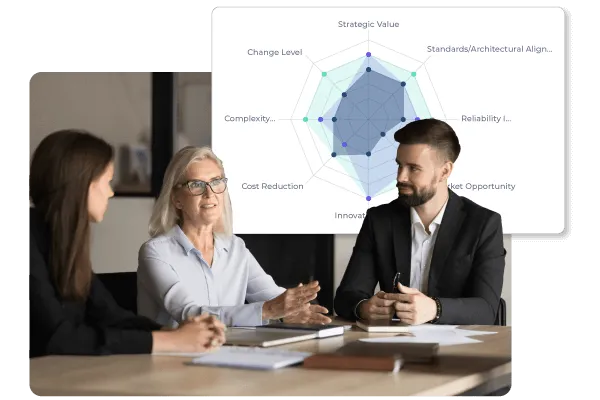
Your application landscape is growing. Without a governed view, decisions on investment, rationalization, and change become guesswork. OrbusInfinity gives you clarity.
When your portfolio is invisible, every decision is a risk
Most organizations manage their application landscape across spreadsheets, siloed wikis, and outdated diagrams. The result is often redundancy, missed dependencies, and poor investment decisions.
No single source of truth
Teams rely on fragmented records to understand the application portfolio. Decisions are made on incomplete data, creating risk and rework.
Invisible dependencies and impact
Without a mapped view of application relationships, change impact is unknown until it is too late. Integration failures and project delays follow.
Portfolio decisions without context
Rationalization, investment, and retirement decisions are made without a clear picture of capability coverage, lifecycle status, or technical debt.
Your architecture mapped
One platform. Your complete application picture.
OrbusInfinity structures your application architecture from catalogue to capability map to dependency model, so every stakeholder works from the same governed baseline.
Application Portfolio Catalogue
Build and maintain a structured, governed record of every application in your estate.
- Capture owner, lifecycle status, and business criticality
- Filter and search across the full portfolio
- Keep records current with collaborative editing

Capability-to-Application Mapping
See which business capabilities are supported, over-served, or under-served by your current portfolio.
- Link applications directly to capability models
- Identify redundancy and coverage gaps
- Inform rationalization and investment decisions
Dependency and Integration Modelling
Map application-to-application relationships to understand integration patterns and change impact.
- Model integration flows and data exchanges
- Trace upstream and downstream dependencies
- Assess impact before committing to change
Lifecycle Status Management
Assign and track lifecycle status across the portfolio to guide rationalization and roadmap planning.
- Tag applications as invest, maintain, retire, or replace
- Visualize lifecycle transitions over time
- Align portfolio decisions to strategy
Stakeholder-Ready Views and Heat Maps
Generate configurable views that communicate application architecture to technical and non-technical audiences.
- Portfolio dashboards filterable by status and domain
- Capability heat maps color-coded by investment level
- Dependency diagrams for impact analysis
Cross-Domain Traceability
Connect application architecture to business, data, technology, and security domains in one platform.
- Link applications to data assets and technology components
- Trace security controls to the application layer
- Maintain end-to-end architecture coherence

Not One Size Fits All
Every stakeholder needs a different view. Now they have one.
Application architecture decisions span the C-suite, architecture practice, and delivery teams. OrbusInfinity surfaces the right information for each role, in one connected platform.

CIO and CTO
Portfolio clarity for confident investment decisions
See the full application landscape; lifecycle status, capability coverage, and cost exposure, to make investment and rationalization calls with confidence.
- Understand total portfolio scope and cost exposure
- Identify redundant or end-of-life applications
- Align technology investment to business priorities
- Communicate portfolio strategy to the board
Enterprise Architect
A governed, living application architecture baseline
Maintain a single, authoritative application catalogue that stays current. Map capabilities, model dependencies, and produce stakeholder-ready views, all from one governed source.
- Maintain current and target state application maps
- Model integration and dependency relationships
- Produce heat maps and views without manual effort
- Connect application decisions to the wider EA framework
Solution & Technical Design Lead
Design within a known, governed application context
Understand the application constraints and integration patterns that apply before you design. Avoid rework by starting from a governed baseline, not assumptions.
- Access the authoritative application catalogue
- Understand existing integration patterns and dependencies
- Identify which applications are in scope for your solution
- Align solution designsStill to the application architecture baseline
Latest Success Stories
.webp)




.avif)



.svg)











.svg)































































Still using spreadsheets?
Ungoverned portfolios cost more than the tool that fixes them
Book a demo to see how OrbusInfinity structures your application portfolio, from catalogue to capability map to stakeholder-ready views.