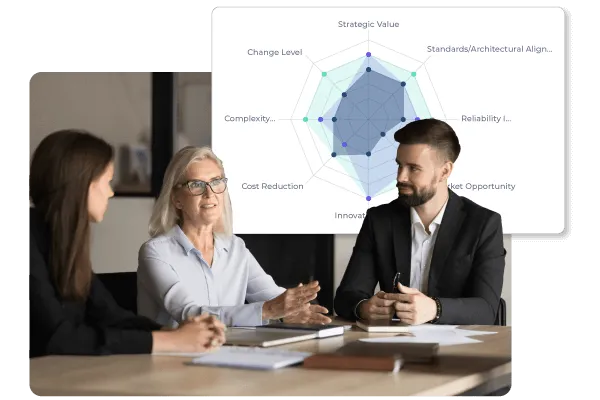
Business architecture
Turn CX Strategy into Operational Reality
Most enterprises have a customer experience strategy. Few can execute it exactly to plan. OrbusInfinity connects your CX vision to the capabilities, journeys, and operating model that deliver it.
The Gap Between CX Vision and Execution
Enterprise CX leaders face a common problem: strategy exists at the top, but the capabilities, processes, and operating model beneath it remain disconnected and opaque.
Strategy Disconnected from Operations
CX strategy sits in slide decks while the capabilities and processes that actually serve customers remain unmapped and unmanaged. Transformation stalls before it starts.
Journey Maps That Go Nowhere
Static journey maps capture the customer view but ignore the operational reality beneath. Without links to capabilities and value streams, they cannot drive meaningful change.
No Shared View Across CX and Architecture
CX, operations, and architecture teams work from different models and tools. Misalignment slows decisions, duplicates investment, and leaves capability gaps unaddressed.
Where CX Strategy gets real
One Connected Model for CX Strategy and Execution
OrbusInfinity gives Customer Experience and architecture teams a shared platform to map journeys, model capabilities, design operating models, and plan transformation in one connected environment.
Customer Journey Mapping
Build interactive customer journey maps that link every touchpoint to the capabilities, value streams, and processes that deliver the experience.
- Map journeys across channels and customer segments
- Link touchpoints to underlying business capabilities
- Identify where operational gaps create customer friction

CX Capability Model and Heat Map
Design a structured CX capability model and assess maturity across your enterprise. Visualize gaps and prioritize investment with a capability heat map.
- Build a structured customer experience capability map
- Assess current vs. target capability maturity
- Prioritize CX investments based on gap analysis
Customer Experience Operating Model
Visualize and communicate your CX operating model across people, process, technology, and data. Give every stakeholder a single authoritative view.
- Design your customer experience operating model
- Align CX, operations, and IT on a shared model
- Communicate operating model changes to all stakeholders
CX Transformation Roadmap
Plan and sequence your CX transformation initiatives against capability targets and strategic milestones. Connect roadmap to portfolio and strategy execution.
- Build a structured CX transformation roadmap
- Sequence initiatives against capability development targets
- Connect CX roadmap to enterprise strategy and portfolio

Your Role. Your View.
One Model. Every CX Stakeholder.
CX transformation stalls when leaders work from different versions of the truth. OrbusInfinity gives each stakeholder, from Customer Officers to the Business Architect, a single, connected model of the journey, the capabilities behind it, and the gaps blocking improvement.

Chief Experience Officer / Chief Customer Officer
Own the CX Strategy End to End
Connect your CX vision to the operating model and capabilities that deliver it. Communicate strategy clearly and track progress against transformation goals.
- Align CX strategy with enterprise architecture and portfolio
- Visualize the full CX operating model in one view
- Identify capability gaps blocking customer outcomes
- Report CX transformation progress to the board
Chief Operating Officer
Operationalize CX Across the Enterprise
Understand which operational capabilities and value streams drive customer experience. Make informed decisions about process improvement and resource allocation.
- Map value streams to customer journey touchpoints
- Identify operational root causes of CX friction
- Align operations and CX teams on shared priorities
- Track capability development against CX targets
Head of Business Architecture
Connect CX to the Architecture Framework
Integrate customer experience models into your enterprise architecture. Provide CX and operations teams with a structured, reusable capability and journey framework.
- Build a reusable CX capability and journey model
- Link CX models to enterprise architecture artifacts
- Support CX transformation with structured gap analysis
- Enable stakeholder alignment with role-based views
Latest Success Stories
.webp)





.avif)



.svg)










.svg)



























































Take a closer look
Connect Your CX Strategy to the People & Capabilities That Deliver It
See how OrbusInfinity links customer journeys, capability models, and transformation roadmaps in one connected platform. Book a 30-minute demo with our team.