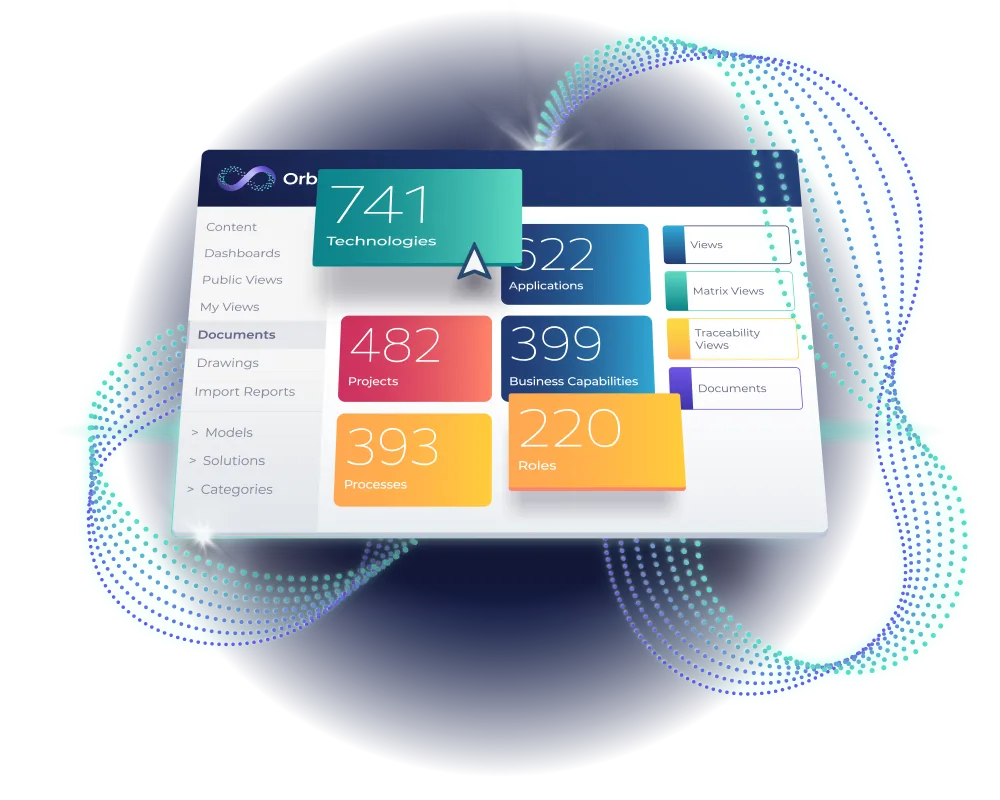
Architect. Align. Transform
Enterprise Architecture Management
Connect strategy to execution with a unified enterprise architecture platform built for complex, fast-moving organizations.

Common Enterprise Architecture Challenges
Fragmented data, misaligned teams, and governance gaps make enterprise architecture harder to sustain.
Siloed data across domains
Architecture data scattered across spreadsheets, wikis, and disconnected tools creates blind spots. Without a single source of truth, teams duplicate effort and decisions are made on incomplete, out-of-date information.

IT and Business Misalignment
When architecture work lives inside IT, business leaders disengage. Strategic initiatives stall because technology decisions lack clear links to business capabilities, outcomes, or investment priorities.

Weak Governance and Standards Adoption
Inconsistent modeling standards, ungoverned metamodels, and limited stakeholder access undermine architecture quality. Without clear governance, EA programs struggle to demonstrate value or scale across the enterprise.


Trusted by hundreds of organizations for Enterprise Architecture SaaS






What you can achieve
Drive value with enterprise architecture
OrbusInfinity gives EA teams the platform to turn architecture into a strategic business asset.

Strategic clarity
Connect enterprise architecture to business strategy, giving CIOs and architects a shared, authoritative view of the organization's current and target states.

Governed agility
Enforce architecture standards and governance frameworks while giving teams the flexibility to model, collaborate, and adapt as business priorities evolve.

Informed decisions
Surface cross-domain insights through dashboards, impact analysis, and AI-powered views that help decision-makers act with confidence across the full enterprise landscape.
Platform capabilities
How OrbusInfinity powers enterprise architecture
Retire manual processes, eliminate your data quality issues, and uncover hidden insights. With OrbusInfinity Flow and OrbusInfinity AI, your team gains access to connectivity with 150+ business applications and 22 AI-driven features, recognized as market-leading by Forrester.
Unified EA Repository
A web-based, centralized repository provides a single source of truth for all architecture content across domains.
Modeling & diagramming
Native diagramming via OrbusInfinity Draw and our Visio integration deliver powerful, repository-connected diagramming for every EA domain however you like to work.
Configurable Metamodel
Adapt our out-of-the-box CoreEA metamodel to your frameworks and standards; TOGAF, ArchiMate, or custom notations.
Dashboards & AI Insights
Role-based dashboards, heatmaps, and AI chart capabilities surface the insights stakeholders need to act.
Broad Integration Ecosystem
Connect to 150+ enterprise systems via out-of-the-box integrations, REST API, and AI-driven iPaaS automation.
Stakeholder Collaboration
Workspaces, surveys, and collaborative sites engage business and technology owners across the full enterprise.
Customer Success Stories
.webp)





.avif)




.svg)











.svg)




























































Explore further
Enterprise architectural use cases
OrbusInfinity supports every architecture domain. Explore the use cases that matter most to your organization.

Get Started
Let's talk about getting OrbusInfinity Working for you