Enterprise Architecture
Application Architecture
Your application landscape is growing. Without a governed target application model, decisions about investment, rationalization, and change can drift away from the architecture you’re trying to achieve. OrbusInfinity gives you the clarity to guide delivery decisions.
When your portfolio lacks visibility, every decision increases risk
Most organizations manage their application landscape across spreadsheets, siloed wikis, and outdated diagrams. The result is often redundancy, missed dependencies, and poor investment decisions.
No single source of truth
Teams rely on fragmented records to understand the application landscape. Decisions are made on incomplete data, creating risk and rework.

Invisible dependencies and impact
Without a mapped view of application relationships, change impact is unknown until it is too late. Integration failures and project delays follow.

Portfolio decisions without context
Rationalization, investment, and retirement decisions are made without a clear picture of capability coverage, lifecycle status, the target model, or technical debt.

Your architecture mapped
One platform. Your complete application blueprint.
OrbusInfinity structures your application architecture from catalogue to capability map to dependency model, so every stakeholder works from the same governed baseline.
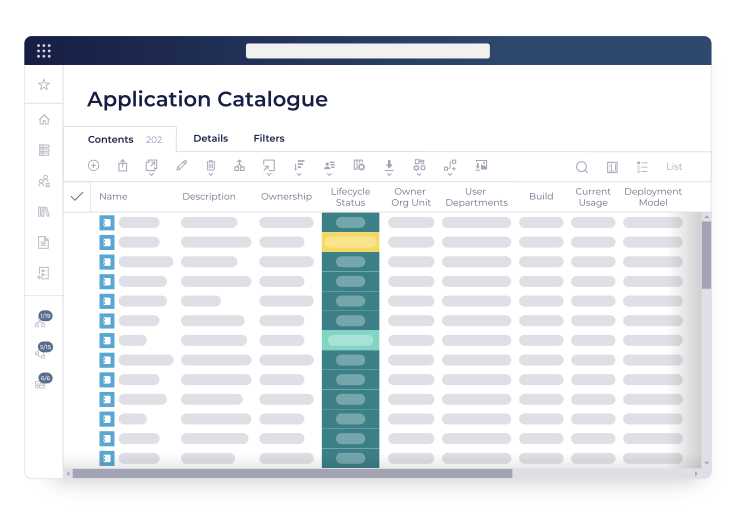
Application Inventory
Build and maintain a structured, governed record of every application in your estate.
- Capture owner, lifecycle status, and business criticality
- Filter and search across the full portfolio
- Keep records current with collaborative editing
Capability-to-Application Mapping
See which business capabilities are supported, over-served, or under-served by your current portfolio.
- Link applications directly to capability models
- Identify redundancy and duplication
- Inform rationalization and investment decisions
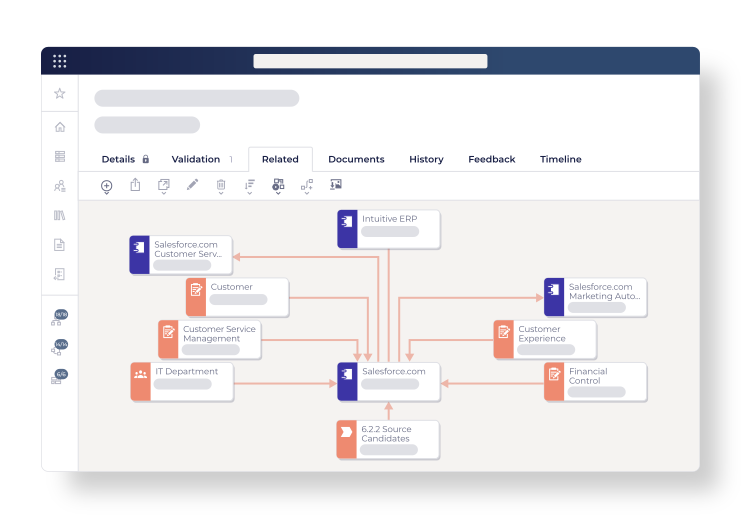
Dependency and Integration Modeling
Create application-to-application relationships to understand integration patterns and change impact.
- Model integration flows and data exchanges
- Trace upstream and downstream dependencies
- Assess impact before committing to change
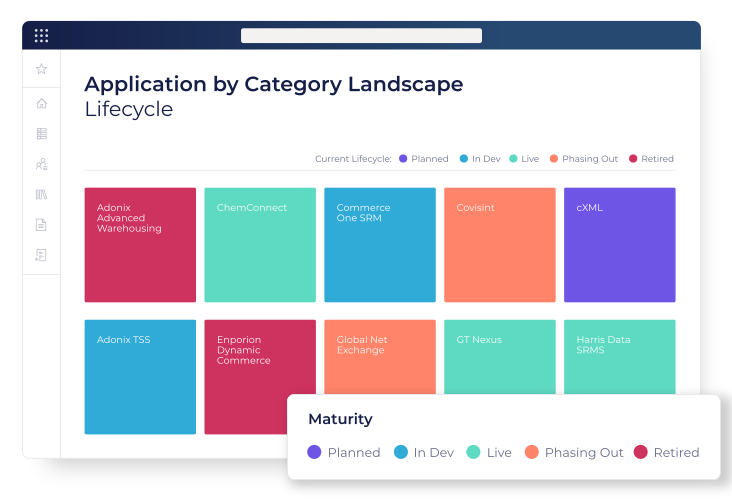
Application Category Mapping
Classify applications by business capability and functional category to quickly understand coverage, overlap, and gaps across the enterprise.
- Map applications to business capabilities and functional categories
- Search, filter, and compare coverage across domains and business units
- Identify duplication, gaps, and rationalization opportunities with evidence
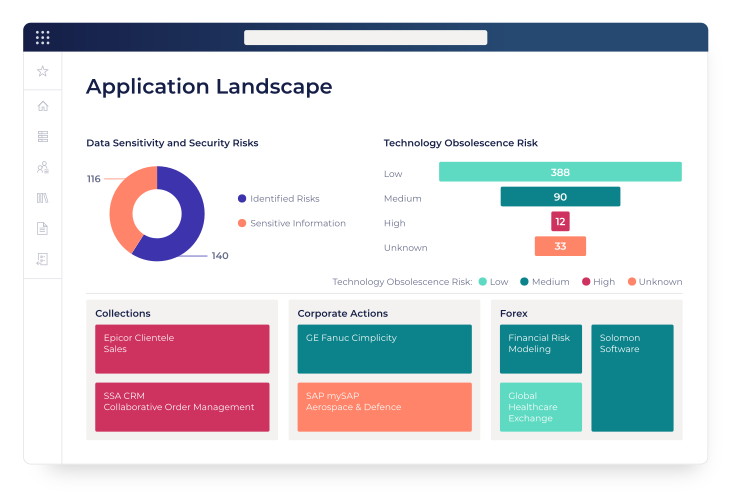
Stakeholder-Ready Views and Heat Maps
Generate configurable views that communicate application architecture to technical and non-technical audiences.
- Dashboards filterable by status and domain
- Capability heat maps color-coded by investment level
- Dependency diagrams for impact analysis
Cross-Domain Traceability
Connect application architecture to business, data, technology, and security domains in one platform.
- Link applications to data assets and technology components
- Identify security controls to the application layer
- Maintain end-to-end architecture coherence
Latest Success Stories

Not One Size Fits All
Every stakeholder needs a different view. Now they have one.
Application architecture decisions span the C-suite, architecture practice, and delivery teams. OrbusInfinity surfaces the right information for each role, in one connected platform.

CIO / Chief Technology Officer
CIO, CTO
Portfolio clarity for confident investment decisions
See the full application landscape; lifecycle status, capability coverage, and cost exposure, to make investment and rationalization calls with confidence.
- Understand how the application landscape supports business capabilities and outcomes
- Identify overlap, gaps, and misalignment that block priority initiatives and target-state progress
- Guide architecture decisions so change and investment advance business priorities consistently
- Communicate portfolio strategy to the board

Enterprise Architect
A governed, living application architecture baseline
Maintain a single, authoritative application catalogue that stays current. Map capabilities, model dependencies, and produce stakeholder-ready views, all from one governed source.
- Maintain current and target state application maps
- Model integration and dependency relationships
- Produce heat maps and views without manual effort
- Understand the impacts of application decisions on the business

Solution & Technical Design Lead
Solution & Tech Design Leads
Design within a known, governed application context
Understand the application constraints and integration patterns that apply before you design. Avoid rework by starting from a governed baseline, not assumptions.
- Access the authoritative application catalog
- Understand existing integration patterns and dependencies
- Identify which applications are in scope for your solution
- Align solution designs to the application architecture baseline

Common Questions
Application architecture FAQs
Application architecture defines the structure, relationships, and behavior of applications within an enterprise, mapping how applications connect to business capabilities, integrate with each other, and change over time. For business and technology leaders, a governed application architecture is what replaces guesswork with evidence: it provides the clarity needed to make confident decisions about where to invest, what to rationalize, and which changes carry the most risk before committing resources.
OrbusInfinity provides a structured environment to catalogue applications, map them to business capabilities, model dependencies, and assign lifecycle status across the full portfolio. For CIOs, CTOs, and enterprise architects, this means replacing fragmented spreadsheets and siloed records with a single, governed source of truth that makes portfolio decisions confident, defensible, and communicable to every stakeholder from the architecture team to the board.
Application architecture defines the enterprise-wide portfolio, its capability coverage, integration patterns, and lifecycle status, establishing the known context and constraints within which all technology decisions should be made. Solution architecture designs specific solutions and integrations within those constraints, focused on delivering a particular outcome. In OrbusInfinity, solution designers access the authoritative application catalogue and existing dependency models before they design, which means they avoid building on assumptions that lead to rework, integration conflicts, or duplication of capabilities the enterprise already has.
Application architecture is a domain within enterprise architecture, alongside business, data, technology, and security architecture. OrbusInfinity connects all domains, so application decisions are made in the context of the full enterprise architecture rather than in isolation. When these domains are managed separately, organizations routinely make application changes that create unintended data governance gaps, introduce security exposure, or conflict with technology standards because no one had a connected view of all the dependencies at the time the decision was made.
Mapping applications to business capabilities gives leaders a clear picture of where the technology portfolio is aligned to what the business actually needs to deliver, and where it is not. OrbusInfinity connects application records directly to business capability models, revealing which capabilities are well supported, which are being served by too many overlapping tools, and which have no adequate technology support at all. This view is what makes rationalization and investment decisions defensible rather than directional, because every choice is grounded in a structured, evidence-based picture of capability coverage rather than opinions about which applications matter.
Application dependency mapping is the process of documenting how applications connect to each other, what data they exchange, and how changes in one system affect others downstream. Without this visibility, even well-planned change programs routinely trigger unexpected integration failures because the team committing to the change did not have a complete picture of what depended on the system they were modifying. OrbusInfinity models application-to-application relationships and integration flows so that architects and delivery teams can trace upstream and downstream dependencies before committing to a change, assess the full impact across the portfolio, and sequence work in a way that avoids disruption to systems and services the business relies on.
An application landscape is a structured, governed view of all the applications an organization runs, showing how they relate to business capabilities, which teams own them, what lifecycle status they carry, and how they connect to each other through integrations and data flows. For business leaders, the application landscape matters because it is the foundation for every significant technology investment decision.
Without a clear picture of what exists, where it is duplicated, and what it costs to maintain, organizations routinely invest in new capabilities they already have, carry applications past their useful life, and make change decisions without understanding the downstream consequences. OrbusInfinity makes the application landscape visible, governed, and stakeholder-ready so every investment and rationalization decision is grounded in evidence rather than assumption.
Cloud migration planning depends on having an accurate, governed view of the current application landscape before any migration decisions are made. Without knowing which applications are cloud-ready, what depends on each other, and which carry lifecycle risk that makes migration urgent, cloud programs routinely move the wrong workloads first, discover unexpected dependencies midway through, or end up with higher costs than the on-premises environment they replaced.
OrbusInfinity supports cloud migration planning by giving teams a complete application catalogue with lifecycle status, dependency maps, and capability coverage data so migration candidates can be identified, sequenced, and de-risked before the program begins rather than discovering problems after resources have been committed.
Delivery teams routinely spend time and budget on rework when they design solutions without a clear, current view of the existing application landscape and its integration patterns. This happens because the architecture baseline they are working from is outdated, incomplete, or stored in documents that are not kept current. OrbusInfinity gives solution designers and technical leads access to a governed, authoritative application catalogue that reflects the current state of the portfolio, including existing integrations, dependency relationships, and lifecycle status. Starting from this baseline means teams can identify which applications are in scope for their solution, understand what integration patterns already exist, and avoid building capabilities or integrations that duplicate what the organization already has, which reduces rework, integration conflicts, and the cost of late-stage change.