Architect. Align. Transform.
Enterprise Architecture Management
Connect strategy to execution with a unified enterprise architecture platform built for complex, fast-moving organizations.

Common Enterprise Architecture Challenges
Fragmented data, misaligned teams, and governance gaps make enterprise architecture harder to sustain.
Siloed Data Across Domains
Architecture data scattered across spreadsheets, wikis, and disconnected tools creates blind spots. Without a single source of truth, teams duplicate effort and decisions are made on incomplete, out-of-date information.

IT and Business Misalignment
When architecture work lives inside IT, business leaders disengage. Strategic initiatives stall because technology decisions lack clear links to business capabilities, outcomes, or investment priorities.

Weak Governance and Standards Adoption
Inconsistent modeling standards, ungoverned metamodels, and limited stakeholder access undermine architecture quality. Without clear governance, EA programs struggle to demonstrate value or scale across the enterprise.

What You Can Achieve
Drive Value with Enterprise Architecture
OrbusInfinity gives EA teams the platform to turn architecture into a strategic business asset.
Strategic Clarity
Connect enterprise architecture to business strategy, giving CIOs and architects a shared, authoritative view of the organization's current and target states.
Governed Agility
Enforce architecture standards and governance frameworks while giving teams the flexibility to model, collaborate, and adapt as business priorities evolve.
Informed Decisions
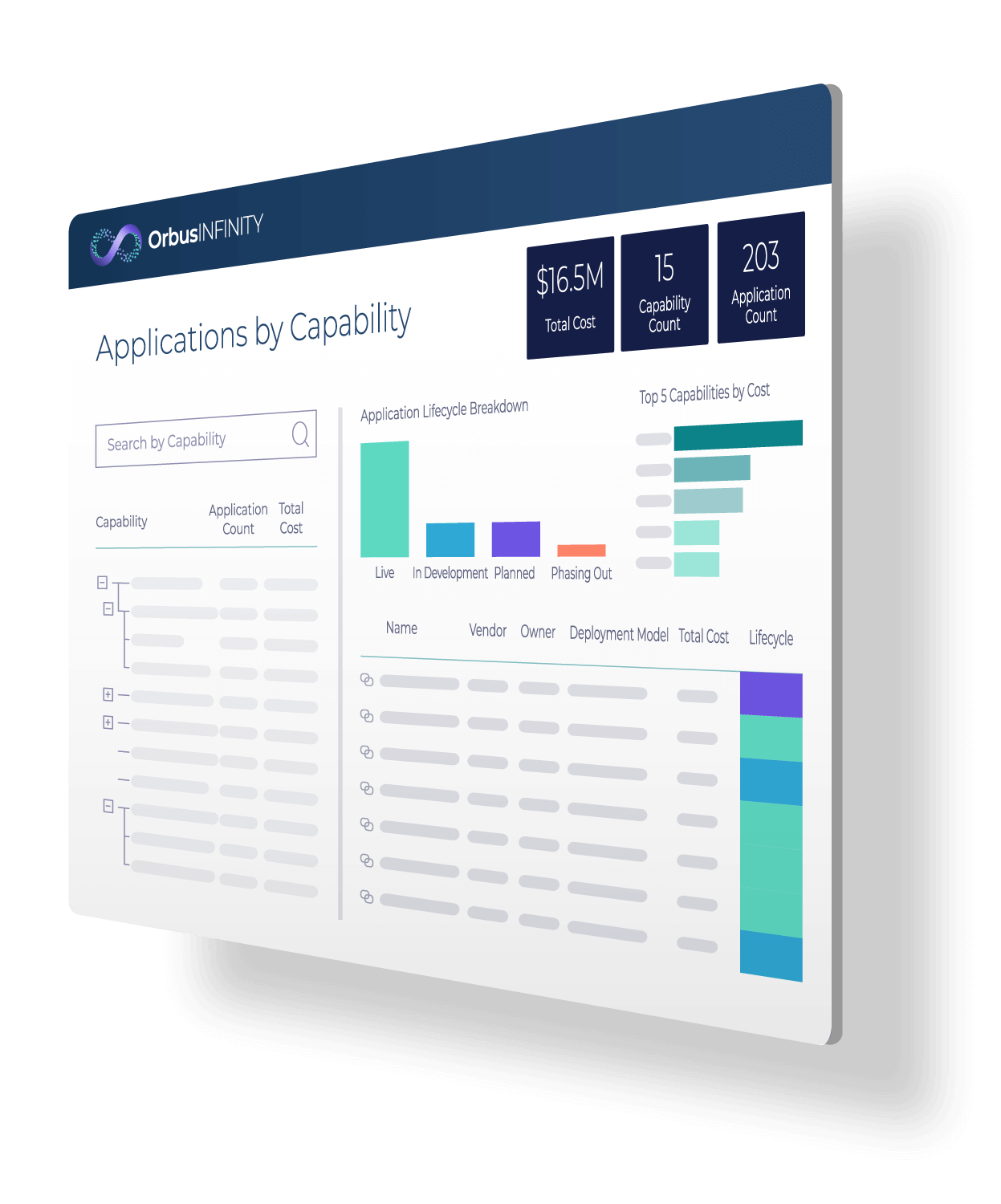
Surface cross-domain insights through dashboards, impact analysis, and AI-powered views that help decision-makers act with confidence across the full enterprise landscape.
Portfolio Rationalization
Identify redundant applications, quantify tech debt, and prioritize investments with out-of-the-box accelerators.
Platform Capabilities
How OrbusInfinity Powers Enterprise Architecture
A purpose-built EA platform with the depth and flexibility to support every architecture domain and stakeholder.
Unified EA Repository
A web-based, centralized repository provides a single source of truth for all architecture content across domains.
Modeling & Diagramming
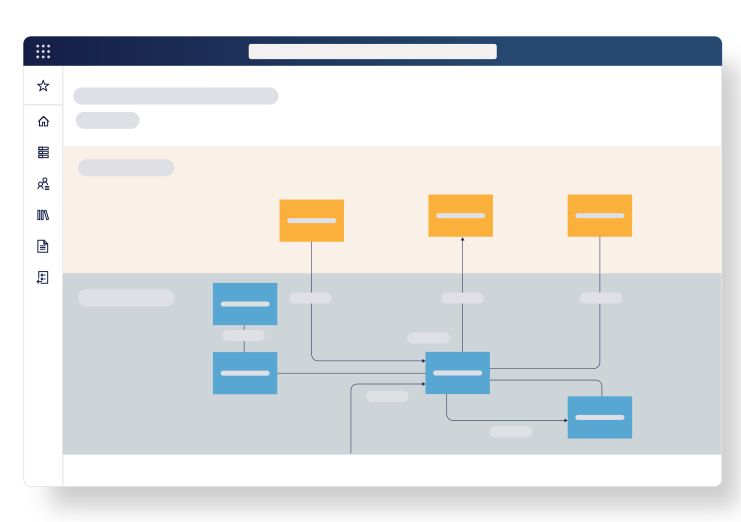
Native diagramming via OrbusInfinity Draw and our Visio integration deliver powerful, repository-connected diagramming for every EA domain however you like to work.
Configurable Metamodel
Adapt our out-of-the-box CoreEA metamodel to your frameworks and standards; TOGAF, ArchiMate, or custom notations.
Dashboards & AI Insights
Role-based dashboards, heatmaps, and AI chart capabilities surface the insights stakeholders need to act.
Stakeholder Collaboration
Workspaces, surveys, and collaborative sites engage business and technology owners across the full enterprise.
Latest Success Stories

Explore Further
Enterprise Architecture Use Cases
OrbusInfinity supports every architecture domain. Explore the use cases that matter most to your organization.

Application Architecture
Model and govern your application landscape to align systems with business capabilities and strategy
Data Architecture
Define and manage data structures, flows, and governance to support trusted, enterprise-wide data decisions.
Technology Architecture
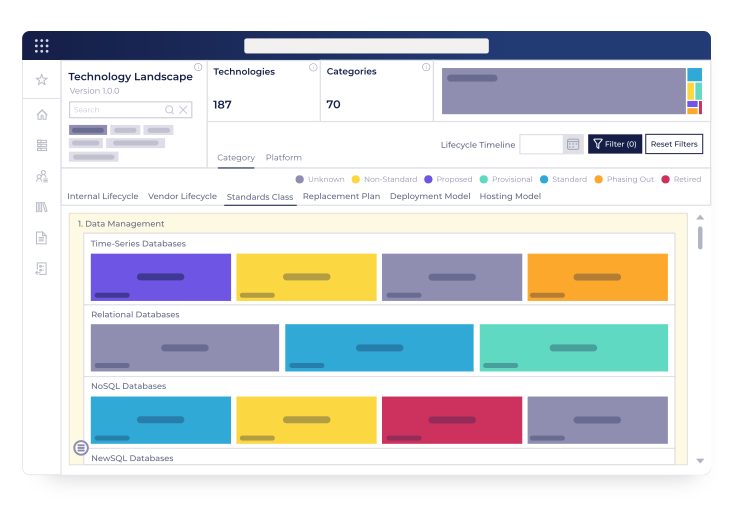
Maintain a clear view of your technology landscape to manage risk, obsolescence, and investment priorities.
Security Architecture
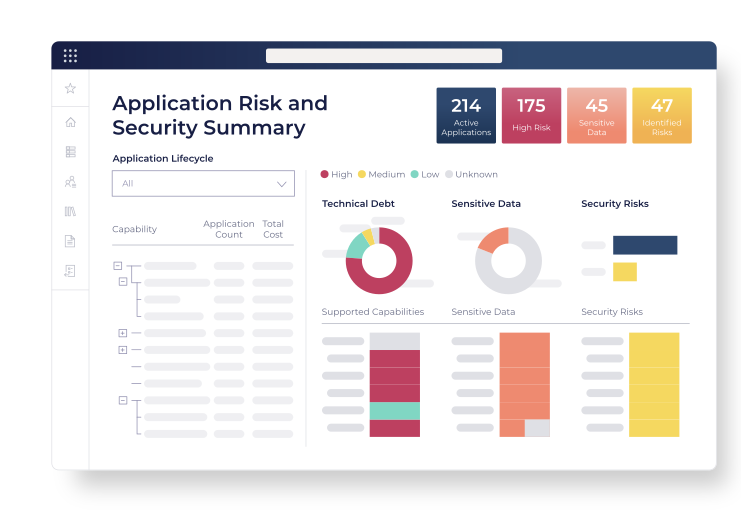
Map security controls and risks across your enterprise to strengthen resilience and maintain compliance.
Common Questions
Enterprise Architecture: Frequently Asked Questions
Enterprise architecture is the practice of aligning an organization's business strategy, processes, data, applications, and technology into a coherent, governed blueprint for transformation. In practical terms, it gives CIOs and business leaders a structured way to understand how their organization works today, where it needs to go, and what changes to technology and operations are needed to get there. Without it, transformation programs often stall, investments get misaligned, and change becomes reactive rather than planned.
Enterprise architecture gives organizations a structured foundation for strategic decision-making. Key benefits include clearer alignment between IT investment and business priorities, reduced duplication across applications and systems, faster and more confident responses to change, and a governed framework that keeps technology decisions consistent across teams and geographies. For CIOs, it also provides the evidence base needed to justify investment and demonstrate the value architecture work delivers to the business.
OrbusInfinity supports industry-standard enterprise architecture frameworks including TOGAF, the most widely adopted EA framework globally, and ArchiMate, the standard notation for modeling enterprise architectures. Beyond these, OrbusInfinity provides a configurable metamodel that allows teams to align to any standard or adapt the platform to custom notations and organizational conventions, making it suitable for organizations at any stage of EA maturity.
OrbusInfinity provides everything needed to run enterprise architecture at scale: a centralized repository that becomes the single source of truth for all architecture content, modeling and diagramming tools for every EA domain, configurable governance frameworks, role-based dashboards, and 150+ integrations that keep architecture data connected to the rest of the enterprise. Together these capabilities give EA teams the foundation to move from documentation to decision support, turning architecture into a platform for strategic action rather than a record-keeping exercise.
OrbusInfinity supports the full range of enterprise architecture use cases from a single connected platform. This includes application, data, solution, technology, and security architecture across every domain, as well as broader use cases such as IT portfolio management, strategic planning, and business transformation. Because all of these are managed within one repository, architecture decisions made in one domain are immediately visible and traceable across all others.
Enterprise architecture sets the organizational blueprint; solution architecture designs within it. EA operates at the enterprise level, governing the full landscape of business capabilities, applications, data, and technology. Solution architecture works at the project or initiative level, designing the specific technical solution that meets a defined business requirement. OrbusInfinity supports both within a single repository, so individual solution designs remain traceable to enterprise standards and strategic objectives.
An enterprise architecture repository is the centralized store where all architecture content, models, diagrams, relationships, and metadata, is governed and maintained. It is the foundation of an effective EA practice because it ensures every team is working from the same accurate, up-to-date picture of the enterprise rather than fragmented local copies. OrbusInfinity's web-based repository provides a single source of truth across all architecture domains, with role-based access, version control, and integration with the broader enterprise technology landscape.
Enterprise architecture operates at the organizational level, providing a governed blueprint that covers the full landscape of business capabilities, applications, data, and technology. Solution architecture works within that framework at the project or initiative level, designing the specific technical solution that meets a defined business requirement. OrbusInfinity supports both, with solution architecture work held in the same repository as the broader EA, so individual solution designs remain traceable to enterprise standards and strategic objectives.
Enterprise architecture plays a foundational role in digital transformation by giving organizations a clear picture of their current state and a governed path to their target state. Without that foundation, transformation programs often run into hidden dependencies, duplicated investment, and misaligned priorities. OrbusInfinity connects enterprise architecture directly to strategic planning, IT portfolio management, and business process management, giving transformation leaders the cross-domain visibility they need to plan, sequence, and govern change at enterprise scale.
A capability model is a structured view of what an organization needs to be able to do in order to deliver on its strategy, independent of how those capabilities are currently organized or supported. In enterprise architecture, capability models are used to assess gaps, prioritize investment, and connect business strategy to the applications and technologies that enable it. OrbusInfinity supports capability modeling as a core part of its EA repository, allowing teams to map capabilities to processes, applications, and strategic goals within a single connected platform.