
From Architecture To Experience: Why Customer Experience Belongs In Business Architecture
Business Architecture has always been good at explaining how an organization works.
Capability models show what the business needs to be able to do. Value streams show how value is created and delivered. Process models and application inventories help us understand the people, activity, and technology behind it all.
These are essential tools. But there is a question traditional Business Architecture has not always answered particularly well:
What does all of this feel like from the outside?
Customers do not experience capability models. They experience a delayed response from customer service, complicated onboarding, repeated questions, or a journey that feels harder than a competitor's.
That gap between how an organization understands itself and how customers experience it is where a lot of strategic value is lost.
Business Architecture describes how an organization works. Customer Experience describes how it feels to interact with that organization. The companies that perform best are the ones that make those two stories align.
The missing link in Business Architecture
This disconnect is not usually caused by a lack of intent. Most organizations genuinely want to deliver a better customer experience. The problem is that business models and Customer Experience artefacts have traditionally been created in separate places.
Journey maps, personas, and service blueprints may be useful during discovery, but they can gradually become disconnected from the organizational decisions that might improve the experience.
Customer Experience should not be treated as a parallel workstream to Business Architecture. It is a natural extension of it - and one of the clearest ways to turn architectural models into strategic action.
Every value stream has a customer on the other end
One of the most useful places to make this connection is in the value stream.
In Business Architecture, a value stream is not simply a process map or a description of internal work. It represents the progressive acquisition of value by a triggering stakeholder. It starts with a trigger, moves through stages, and ends when the stakeholder receives the value they were looking for.
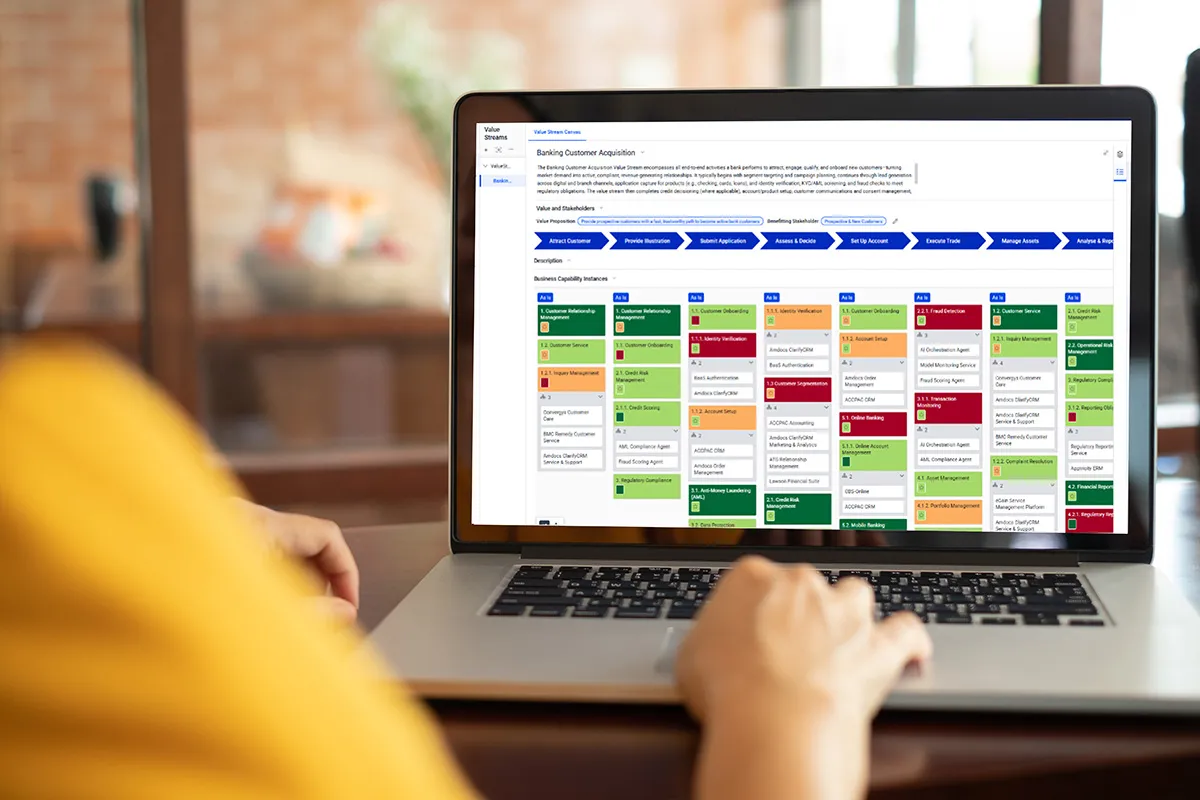
That distinction matters. The purpose is not just to show that work has been completed, but how a stakeholder gets closer to an outcome that matters to them.
When Customer Journey Maps and Value Stream Maps sit alongside one another, we can see where the customer experience breaks down and connect it to the internal activity behind it.
A frustrating moment in onboarding may correspond to a value stream stage where the customer is waiting or unable to move forward. A drop-off in digital engagement may point to a capability gap. A repeated contact-center interaction may reveal that the organization has completed a process step without resolving the customer's need.
The journey makes visible what the value stream implies: every stage exists to move the stakeholder closer to the value they triggered the stream to receive.

That changes Business Architecture from a modelling exercise into a diagnostic tool. Instead of simply documenting how the business is designed, we can identify where investment is most likely to improve the experience customers actually have.
Service blueprints connect the front stage and the back stage
A Customer Journey Map shows what the customer experiences. A Service Blueprint helps explain why.
It connects the front-stage experience - the touchpoints customers see and feel - to the back-stage processes, systems, people, and dependencies that make those moments possible.

On its own, a Service Blueprint is a useful CX artefact. But when it is connected to Business Architecture models, it becomes much more powerful.
Imagine being able to move from a difficult moment in a customer journey to the relevant stage in a value stream, then to the capabilities and systems that support it. That creates a much clearer view of what is actually driving the problem.
Is the issue a process failure? A missing capability? A technology constraint? A hand-off between teams? A policy that creates unnecessary friction? Or is the organization measuring internal efficiency at the expense of the customer outcome?
With those connections in place, the blueprint becomes more than a workshop output. It becomes a live view of how the organization delivers - or fails to deliver - on its promises to customers.
Personas bring the human reality back
Business Architecture can sometimes become too abstract. Capability models and value streams can feel remote from the people who experience the organization.
Personas bring that human reality back into the model.
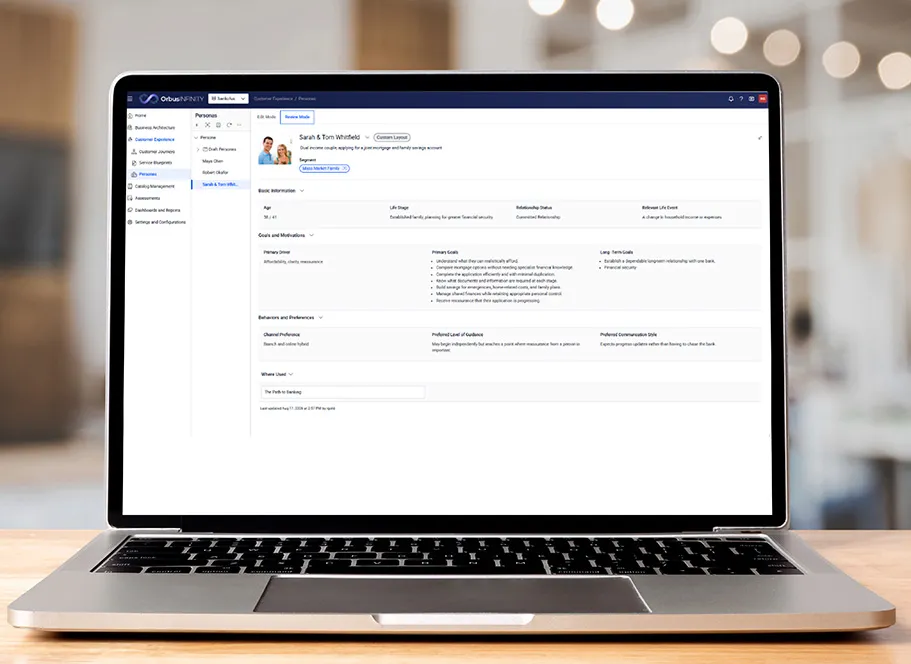
When personas sit alongside journeys, value streams, and capability assessments, they become more than marketing artefacts. They help answer two questions:
- Who is experiencing this journey?
- How well are we delivering the value they expected?
A capability gap can look like a low-priority technical issue in isolation. It takes on a different significance when it is connected to a high-value customer journey and creates friction at a critical point in the experience.
This is the real benefit of a connected model: journeys connect to Service Blueprints, which connect to Value Streams, capabilities, systems, assessments, and investment priorities.
The organization can then be viewed from the inside and the outside at the same time.
Why this is a meaningful differentiator
Many Business Architecture and Enterprise Architecture platforms are designed primarily around the internal view of the organization: applications, capabilities, processes, data, and technology. That view is essential, particularly for CIOs and technology leaders managing complexity and change.
But it is not always enough for Chief Customer Officers, Heads of CX, COOs, or business architects who need to connect internal decisions to external outcomes.
The important distinction is not whether a platform allows someone to draw a journey map. Most tools can do that. The differentiator is whether the journey is connected to the rest of the business model.
A journey map in a standalone tool is an artefact. A journey map connected to value streams, capabilities, systems, and assessments becomes part of the strategic model of the organization.
That connection also broadens the audience for Business Architecture. A Head of CX can see how journeys relate to the capabilities that underpin them. A COO can see where process failures create customer friction. A business architect can connect an architectural recommendation directly to a customer outcome rather than leaving the conversation at the level of models and diagrams.
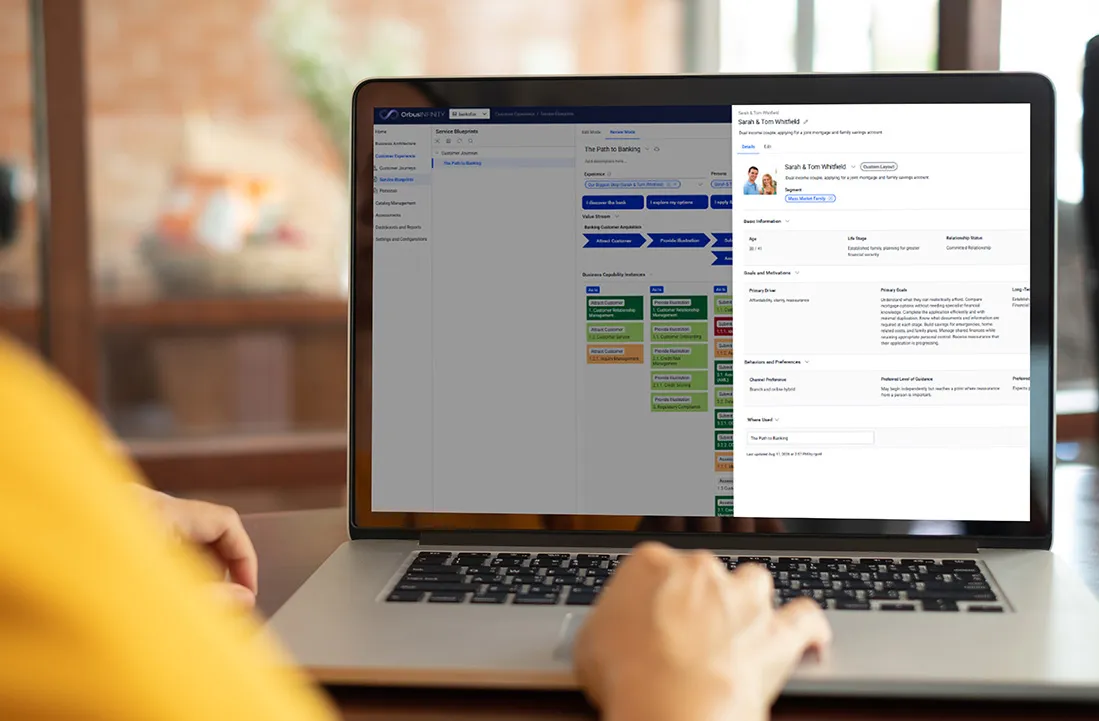
When Business Architecture speaks the language of the customer, it earns a place in more strategic conversations - not just the ones where architects are already present.
The business case: better decisions, not just better models
The obvious executive question is: so what?
Why invest in connecting Customer Experience and Business Architecture? What changes on the bottom line?
The answer is that customer-aware Business Architecture leads to better decisions.
Every organization chooses which capabilities to invest in, which value streams to prioritize, and which operating model changes to pursue. Those choices have consequences for customers, whether or not the connection is explicit.
An organization might improve an internal process because it appears inefficient, while leaving the friction causing customers to leave untouched. It might reduce cost in an area customers barely notice while failing to address a broken hand-off that damages trust and retention.
Looking at the business through the customer's experience helps prevent that kind of misplaced optimization.
It also makes investment prioritization more persuasive. A capability that scores poorly in an assessment is one thing. A capability that scores poorly, supports a value stream stage where customers are not receiving expected value, and creates friction in a high-volume journey is something else entirely.
That is no longer an abstract architectural gap. It is a customer-impact issue, a revenue risk, and a measurable cost of doing nothing.
The analysis itself may not be radically different. The difference is the connection between the parts.
Transformation should start with the customer outcome
Large transformation programs often struggle because they are designed from the inside. Organizations restructure capabilities, replace technology, and redesign operating models - but do not always maintain a clear line of sight to the customer experience - those changes are meant to improve.
The result can be a transformation that reorganizes the backstage while leaving the customer no closer to the value they were seeking.
Connecting Business Architecture and Customer Experience from the start gives transformation programs a practical anchor. It identifies the moments in the journey that matter, the stages where value is not being realized, and the capabilities whose improvement will be felt by customers.
This is not a softer approach to transformation. It is a more precise one. It reduces the risk of spending significant time and money on changes that are internally logical but externally invisible.
Architecture that faces both ways
The best organizations hold two views at once.
They understand how they are structured and how they operate. They also understand what that structure and operation mean for the people they serve.
For too long, those perspectives have lived in separate tools, been maintained by separate teams, and appeared in separate conversations. Bringing them together does more than improve visibility. It changes the role Business Architecture can play.
Customer journeys, Service Blueprints, and Personas are not just useful additions to Business Architecture. They complete the picture. They answer the question every internal model eventually leaves open:
What does this mean for the customer?
For organizations that want architecture to drive strategy, improve operations, and support experiences and customers value, that question is not a nice-to-have.
It should align everything the organization does.
Understand how OrbusInfinity enables Business Architecture.