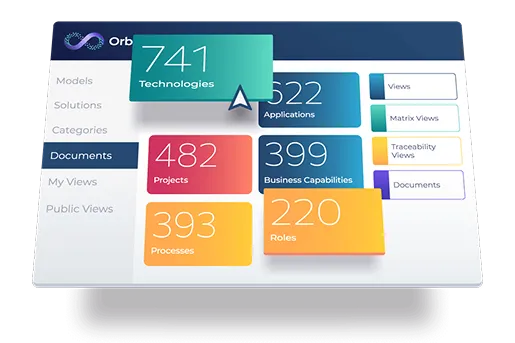



Teams can now find application information themselves, including ownership, costs, lifecycle and dependencies, instead of relying on the EA team to find it for them.
Wan-Pin Van Dyke
Enterprise Architect
The Challenge
Application rationalization was a strategic priority from 2022, but the information needed to act on it sat in spreadsheets maintained by different people.
- Application inventory spread across spreadsheets on a shared drive, maintained separately by different IT leaders
- Inconsistent business ownership and capability data
- No analytics beyond filtering a spreadsheet, and no way to see relationships between applications
- Understanding the impact of a technology change meant searching through multiple documents
- The merger with Piedmont Advantage Credit Union, completed September 1, 2026, required decisions on which applications to retain, replace or retire, alongside contract termination costs and team preferences
The Solution
Truliant started with application portfolio management and added capabilities as its needs changed.
- Began with Orbus iServer to bring the application inventory into one place, then moved to OrbusInfinity as Truliant expanded its use of Microsoft 365
- One inventory covering ownership, costs, vendors, capabilities and lifecycle status
- Mapped how applications relate to and depend on each other, so the team can assess the potential impact of changes
- Dashboards, including a "CIO cockpit", giving IT leaders different views of the portfolio
- Project workspaces and expanded SharePoint document libraries giving solution architects, the PMO, business analysts, process improvement specialists, developers, security teams and business subject matter experts access to current-state and target-state architectures, integration catalogs and requirements
The Result
Application details – ownership, lifecycle status, costs, capabilities, vendors and ecosystems – are in one place, and teams access them without going through the EA team
- Business process mapping draws on existing application and capability data with the Digital Transformation Team, which avoids duplicating work
- Project teams can see how a proposed change might affect existing systems before they plan
- Truliant's past and present CIOs use the dashboards; the CIO who joined in March 2026 requested access immediately and uses them to find gaps in documentation
- An estimated $169,000 in annual value against a $104,000 subscription cost, a potential net benefit of $65,000 and an estimated ROI of 63%, based on Truliant's preliminary draft business case
- 4,800 hours of potential annual savings across 200 applications, and 320 hours across 40 architecture engagements a year
What's next: Truliant plans to work with its infrastructure and operations team on a technology component portfolio, starting with selected pilot areas, and is exploring business architecture while continuing to improve application rationalization and lifecycle visibility.