

In today's fast-paced corporate world, decision - makers are expected to deliver results, drive innovation, and keep their teams aligned with ever-evolving strategies. But here's the problem I keep seeing in my conversations with teams across different organizations: even the smartest leaders struggle to answer a simple question - how do we ensure that everyone, from the C-suite to the front lines, actually moves in the same direction?
I've been both a business analyst and a business architect, and what I've learned from years of sitting in those rooms is this: the challenge isn't usually about having a good strategy. It's about translating that strategy into coordinated action. This is where business architecture enters - not as another buzzword or framework exercise, but as a practical discipline that makes strategy real.
What Is Business Architecture?
At its core, business architecture is a structured approach to describing how a business works and how it delivers value. Think of it as a blueprint for an organization - connecting strategy, people, processes, data, and technology into a unified whole. Just as construction blueprints ensure that all components of a building fit together seamlessly, business architecture ensures that all elements of the organization are aligned and working efficiently toward the same outcomes.
I've seen so many business architects build beautiful models and frameworks, only to watch them gather dust on a shared drive. The difference between a business architecture that sticks and one that doesn't? It needs to start with a real business question. Not "How do we model the organization?" but "How do we make better decisions faster? How do we know if we're wasting resources?"
When you start there - with the business problem, not the framework - business architecture becomes essential infrastructure instead of overhead.
Why Should Decision-Makers Care?
According to Gartner's latest research, nearly 75% of strategists now report that strategy-execution alignment has become a major concern over the past three years [1]. That's not a niche problem - that's the dominant concern for three-quarters of strategy leaders.
McKinsey's 2026 State of Organizations research reveals the real problem: 73% of companies report significant capability gaps when attempting to execute their strategic priorities. [2] You can't will your way past a capability gap - you have to redesign how work flows through your organization.
Here's where it gets expensive: only 26% of executives strongly agreed that their functional KPIs aligned with organizational strategic objectives [3]. That means three out of four companies are measuring success using metrics that don't actually reflect their stated priorities. According to Bain & Company's 2024 research, only 12% of large organizations achieve their original transformation ambitions - 88% fall short [4].
When business architecture is in place, the benefits are clear:
- Strategic Alignment: Every team and piece of work supports the same goals.
- Operational Clarity: Everyone understands how their work fits into the bigger picture.
- Agility: Organizations are 3.4 times more likely to adapt fast enough to respond to disruption when strategy team business partners are highly engaged [5].
- Better Decisions: Leaders have the insight they need to make informed choices.
Research shows that companies adopting an aligned operating model are 2.3 times more likely to rank among the top quartile of healthy, high-performing organizations [6].
The Core Components
For those new to the discipline, here are the foundational elements of business architecture:
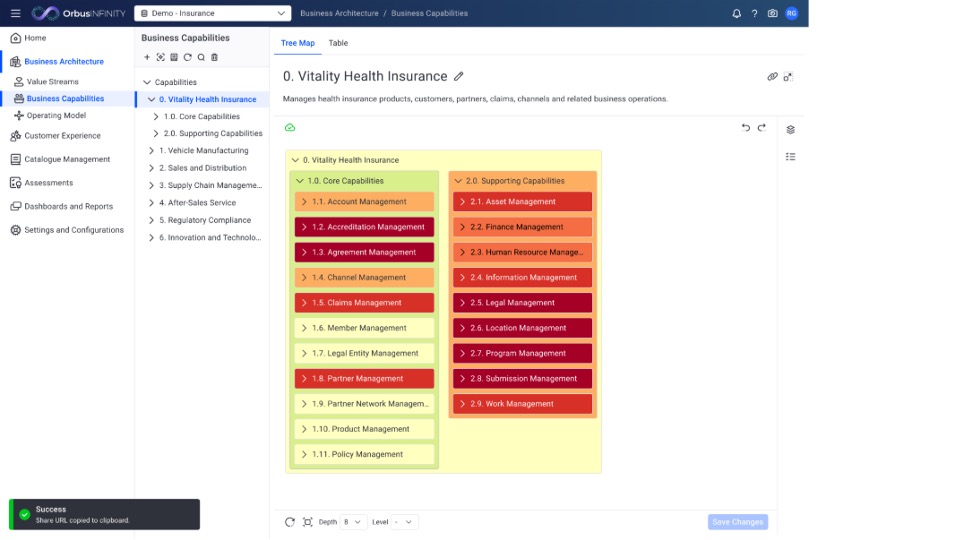
- Business Capabilities: What the organization must be able to do to succeed.
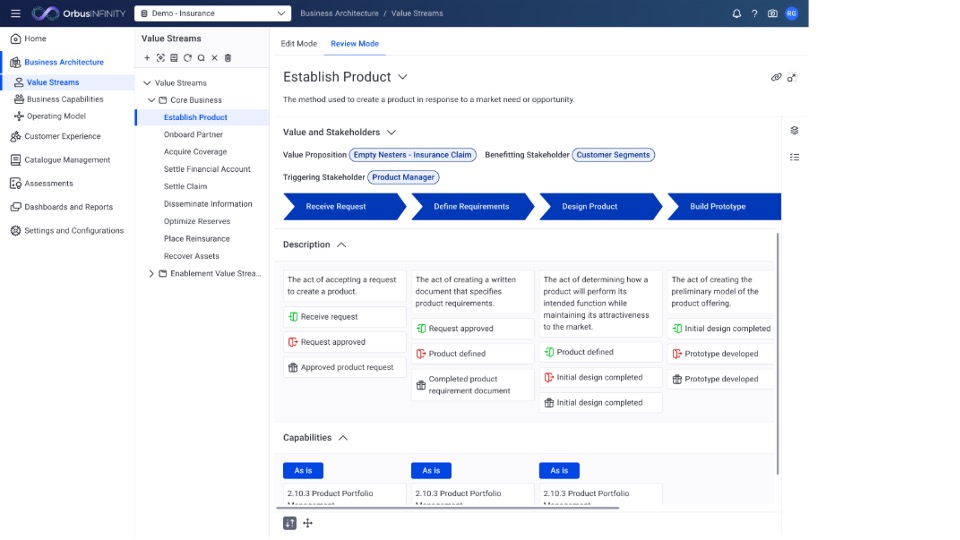
- Value Streams: How value is delivered to customers and stakeholders.
- Organizational Structure: How teams and roles are arranged to support the business.
- Information & Data: The flows of information that power business operations.
- Processes: The workflows that make up the day-to-day business.
- Technology: The systems and tools that enable strategy.
When you map these elements and see how they connect, patterns emerge. You start to notice where your organization is over-investing in one area while starving another. You see bottlenecks that nobody has articulated yet.
Turning Strategy Into Action
Business architecture isn't just about efficiency - it's about purpose. When people, processes, data, and technology are aligned with strategy, the organization becomes more than just well-run; it becomes focused and resilient.
I remember working with a customer in financial services who wanted to "improve decision-making speed." It was a worthy goal, but meaningless until we broke it down: Which decisions? Who makes them? What information do they need? Where does it get stuck? It turned out the bottleneck wasn't decision-making at all - it was data governance. The credit decision team had to wait three days for accurate data from another department. Fix that, and everything moved faster.
That's business architecture at work.
Why This Matters Right Now
The reality is this: 70% of digital transformation initiatives fail to meet their objectives, a rate that has remained consistent for over a decade. [7] Yet $3.4 trillion will be spent on transformation in 2026 alone. [8] That gap between investment and outcome isn't a technology problem. It's a structural misalignment problem.
Organizations are also navigating new complexity. AI is forcing organizations to rethink how decisions get made, what data matters, and how work gets organized. [9] That's creating new sources of misalignment at exactly the moment when teams are already stretched thin.
Where Should Organizations Start?
For organizations ready to put business architecture to work, here's a practical roadmap:
- Start with a Business Question: Not "let's map the enterprise" but "Why are we slow to launch new products?" or "Where is our customer data fragmented?"
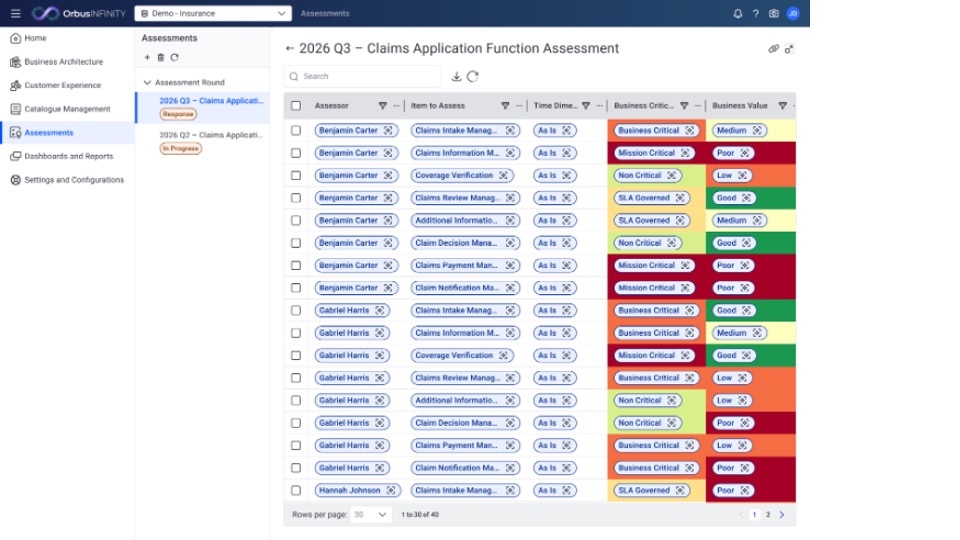
- Assess Your Operating Reality: Map out the existing capabilities, value streams, and structure as they actually are - not as the org chart suggests.
- Define Where You Need to Be: What does success look like, concretely, for how you organize and measure?
- Identify the Gaps and Build a Roadmap: What initiatives bridge the gap between where you are and where you want to be?
- Invest Thoughtfully: Tools amplify thinking - they don't replace it. Start with clarity, boost it with tools.
Final Thoughts
Business architecture is more than a buzzword - it's a strategic discipline that empowers decision - makers to drive clarity, alignment, and innovation. In a world where change is the only constant, it's the blueprint every leader needs to build a resilient, high-performing organization.
The good news? You don't need permission or a multi-million-dollar initiative to start. You just need to ask the right question and be willing to follow the answer.
In the next article, we'll explore who actually uses business architecture and why different stakeholders - from C-suite strategists to CIOs - all benefit from the same clarity. Read "Who Uses Business Architecture? Understanding the Stakeholders" to see which role in your organization needs this alignment most.
About the Author
Rachelle Gold is Vice President of Product with over 20 years of experience in business architecture, product strategy, and cross-functional leadership. She has architected and designed transformational solutions at enterprise scale, including an award-winning global business system that closed significant revenue gaps for a global finance organization. She is recognized for pioneering industry-leading customer adoption programs and translating complex business challenges into scalable, customer-centric product strategies.