Optimize IT Investment
IT Portfolio Management Solutions for Enterprise IT Leaders
See how enterprise IT leaders use IT portfolio management to retire duplicate applications, consolidate systems after a merger, meet regulatory requirements and fund the technology that matters most, along with how to get started with OrbusInfinity.

IT Portfolio Management: Common Challenges
Without a unified view, IT leaders struggle to govern spend, manage risk, and align technology with strategy.
Fragmented Portfolio Visibility
Scattered data across spreadsheets, CMDBs, and siloed teams obscures the IT landscape, leaving CIOs and IT teams with blind spots, growing technical debt, and higher costs from duplicated or unnecessary systems.

Investment Misaligned with Strategy
When IT spend cannot be traced to business outcomes, investment decisions become hard to defend, and unclear objectives and misaligned projects gradually erode value and slow strategic execution.

Uncontrolled Technology Risk
Obsolete applications, untracked lifecycle stages, and ungoverned technology standards create compounding risk, exposing organizations to compliance gaps, security vulnerabilities, and costly remediation.

What Good Looks Like
Govern Your Portfolio with Confidence
OrbusInfinity gives IT leaders the clarity, control, and collaboration needed to optimize every technology decision.
Full Visibility
Consolidate application, technology, and cost data into a single, always-current repository, so every stakeholder works from the same authoritative picture of the IT landscape.
Strategic Alignment
Give budget reviews a clear line from each technology investment to the business capability and strategic goal it serves, so CIOs can defend priorities, redirect spend from capabilities that no longer matter and agree direction with business leaders using the same evidence.
Proactive Governance
Surface technology risk, lifecycle gaps, and compliance exposures before they escalate, keeping your portfolio healthy, governed, and audit-ready across every domain.
Accelerated Improvement Cycles
Spot duplicate and overlapping applications across business units, model retirement and consolidation scenarios before committing, and track each decommissioning against the roadmap so savings are visible to leadership.
Platform Capabilities
Built for End-to-End IT Portfolio Management
OrbusInfinity delivers the tools, data, and insights that turn portfolio complexity into structured, actionable intelligence. For the full feature set and pre-built report packs, explore our IT portfolio management software.
Centralized IT Repository
A web-based, single source of truth for all application, technology, and cost data; accessible across teams and always current.
Out-of-the-Box ITPM Reports
Pre-built reports covering application assessment, lifecycle, impact, and cost, grounded to best practice frameworks.
Automated workflows with OrbusInfinity Flow
A native iPaaS offers complete connectivity that links your CMDB, ITSM, and enterprise systems, automating product and lifecycle data ingestion, and eliminating the manual effort.
Heatmaps, Visualizations and Dashboards
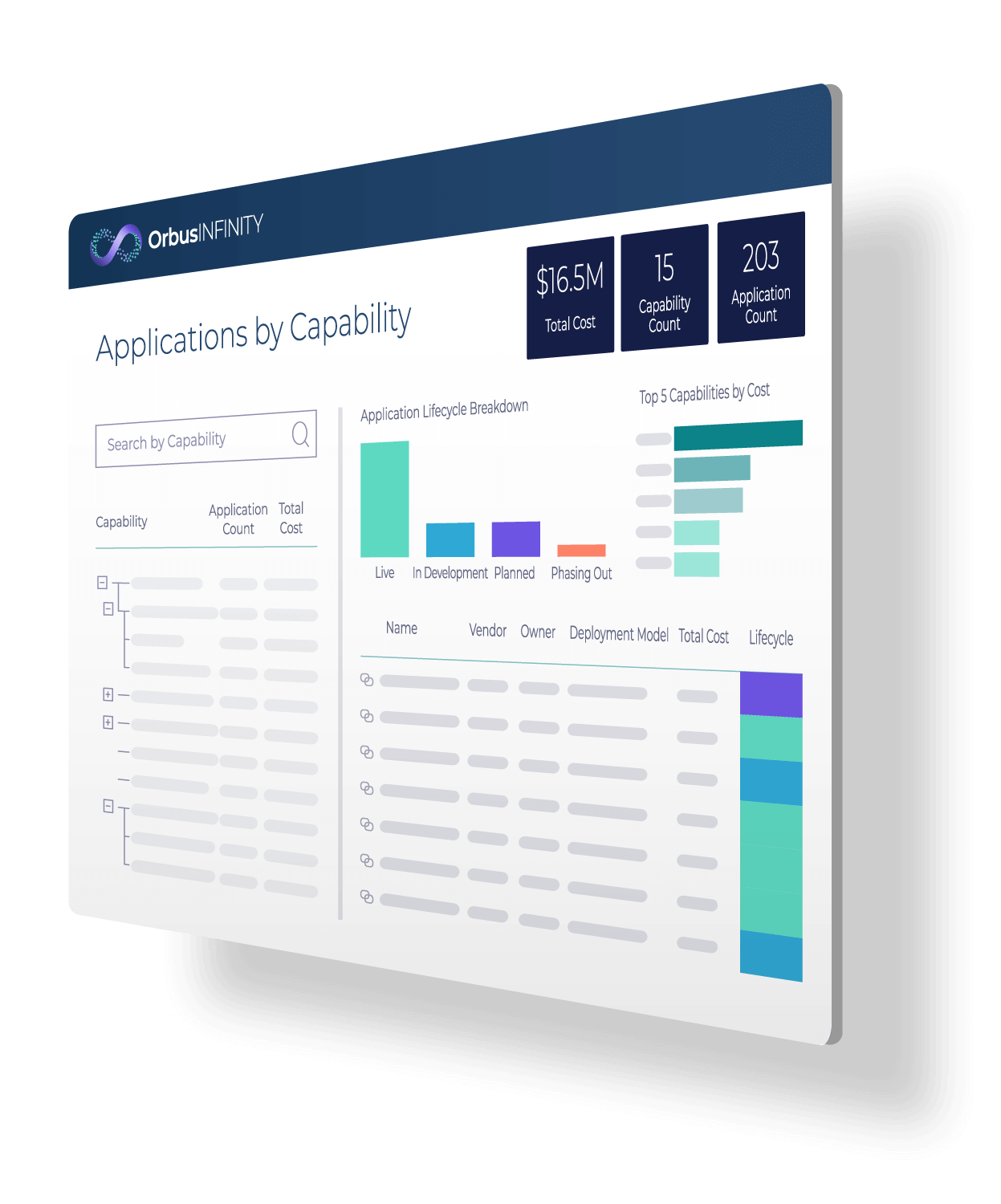
Configurable heatmaps, powerful visualizations, collaborative dashboards and stakeholder sites surface portfolio health, risk exposure, and investment alignment at a glance.
Capability Visualizations
Interactive business capability maps connect strategy, investment, and change priorities so every stakeholder, from CIO to business unit leader, works from the same governed view. For large organizations managing multiple divisions, this replaces fragmented spreadsheets with a single source of architectural truth.
Latest Success Stories

Explore Further
Specialized Use Cases Within Your IT Portfolio
OrbusInfinity supports the full breadth of IT portfolio management through purpose-built, connected use cases.
Introducing
Application and Technology Lifecycle Management
Track and manage the full lifecycle of applications and technologies to plan modernization and avoid obsolescence.
Introducing
Application Portfolio Management
Inventory, assess and govern every business application, then decide which to invest in, tolerate, migrate or retire.
Introducing
Technology Risk Management
Identify, assess, and mitigate technology risks before they impact business continuity or compliance posture.
Introducing
Cloud Migration / Architecture Management
Plan and govern cloud migration initiatives with full visibility of dependencies, risks, and target-state architecture.
Common Questions
IT Portfolio Management: Frequently Asked Questions
Start with a single inventory of your applications, infrastructure and technology costs, then connect each item to the business capabilities it supports. From there, assess the portfolio on value, health, cost and risk, turn the results into investment and retirement decisions on a roadmap, and keep it current through integrations and a regular portfolio review. Most teams start with one high-priority area, such as a cost review or a post-merger consolidation, and expand once the first decisions show results.
IT portfolio management works best as a standing governance forum rather than a single team's project. The CIO usually chairs it and owns the final investment decisions, finance brings budget and contract data, enterprise architects check each decision against standards and the target architecture, and security and risk leaders flag unsupported technology. Business unit leaders join when a decision affects the capabilities they depend on, which keeps IT spend tied to what the business needs.
IT portfolio management software gives CIOs and enterprise architects a centralized, always-current view of their application and technology landscape. It supports rationalization and lifecycle decisions, surfaces risk before it escalates, and provides dashboards and reports that replace manual data collection with structured, evidence-based insight. The result is faster, more defensible investment decisions grounded in accurate portfolio data rather than spreadsheets and assumptions.
Regulations such as the EU's Digital Operational Resilience Act (DORA) expect financial institutions to know which systems support critical functions, who owns them and how technology risk is managed. IT portfolio management provides that evidence by keeping an accountable, current record of applications, dependencies, lifecycle status and risk. Generali Italia used OrbusInfinity to reduce technical debt and improve DORA compliance, and Zurich Cantonal Bank uses it to adapt IT management to regulatory change. Read the Generali Italia case study.
OrbusInfinity brings the full IT portfolio, applications, technologies, costs, and risks, into a single, governed platform. Out-of-the-box reports, heatmaps, and AI-powered insights give teams immediate visibility without lengthy configuration, while 150+ integrations ensure the data stays current by connecting directly to your existing enterprise systems. The result is a platform where IT leaders can govern the full portfolio, align investment with strategy, and make evidence-based decisions from one authoritative source.
IT portfolio management governs the ongoing IT asset landscape, meaning applications, technologies, and standards across their full lifecycle, while IT project portfolio management focuses on the selection, prioritization, and oversight of IT projects and programs. ITPM asks whether the right assets are in place and delivering value, and project portfolio management asks whether the right initiatives are being executed. OrbusInfinity supports both within a single connected platform.
After a merger or acquisition, IT portfolio management gives the combined organization one view of both application estates, so teams can find overlapping systems, decide which platform to keep for each business capability and plan retirements without disrupting operations. Newcastle Greater Mutual Group used OrbusInfinity this way after the merger of Greater Bank and Newcastle Permanent, decommissioning more than 70 applications with 160 more retirements planned. Read the NGM Group case study.
Several established frameworks guide IT portfolio management practice. Gartner's TIME model helps organizations categorize applications for toleration, investment, migration, or elimination. TOGAF provides a governance structure for enterprise architecture decisions. Capability-based planning connects IT investments directly to the business capabilities they need to support. OrbusInfinity is designed to support these frameworks out of the box, giving teams structured templates and reports aligned to best practice from day one. Read more about the Gartner TIME model.
OrbusInfinity Flow connects to 150+ enterprise systems, including CMDBs, ITSM tools, and lifecycle management databases, via pre-built integrations and native iPaaS functionality. This means portfolio data is pulled automatically from the systems your teams already use, keeping your repository current without manual exports or duplicate data entry. IT leaders get an accurate, up-to-date picture of the portfolio without the administrative overhead that typically makes portfolio management unsustainable at scale.
Application rationalization is one of the core outcomes of a mature IT portfolio management practice. By maintaining a governed, current view of your application landscape, including lifecycle status, business value, cost, and risk, IT leaders can identify candidates for consolidation, retirement, or replacement with confidence. OrbusInfinity supports rationalization with structured assessment frameworks, out-of-the-box reports, and heatmaps that surface duplication, technical debt, and obsolescence across the full portfolio. PCCI, for example, used OrbusInfinity to strengthen rationalization across seven companies and save 20 hours a month on CIO reporting. Learn more about application rationalization.
IT portfolio management reduces technology risk by giving leaders continuous visibility into lifecycle gaps, obsolete systems, ungoverned standards, and compliance exposures across the full IT landscape. Rather than discovering risk during an audit or incident, organizations using OrbusInfinity can surface and prioritize risk proactively, using heatmaps, lifecycle tracking, and AI-powered insights to identify where the portfolio is most exposed and act before issues escalate. Learn more about technology risk management.
Effective IT portfolio management links every technology investment to the business capabilities and strategic objectives it is meant to support. Without that connection, IT spend becomes difficult to justify and easy to cut. OrbusInfinity maps applications and technologies directly to business capabilities and strategic goals, giving CIOs and enterprise architects the evidence they need to prioritize investment, defend budget decisions, and demonstrate the value IT delivers to the business.
Technical debt refers to the accumulated cost of maintaining outdated, inefficient, or poorly integrated systems that were not replaced or modernized when they should have been. Left unmanaged, it slows development, increases risk, and inflates operating costs over time. IT portfolio management provides the visibility needed to quantify and prioritize technical debt across the full portfolio. OrbusInfinity surfaces where debt is concentrated, helps leaders assess the cost and risk of inaction, and supports structured remediation planning before debt becomes a strategic liability. Learn more about technical debt management.

.webp)